



Why Faucets Leak
A leaky faucet is rarely random. Most leaks trace back to a handful of worn or damaged components inside the faucet body. Understanding the cause helps you decide whether to fix it yourself or call a plumber.
Dealing with a shower leak instead? Check out our leaky shower head repair guide for step-by-step instructions. For expert help, contact our water heater repair team.
Common Causes by Faucet Type
- Compression faucets (two handles): Worn rubber washers or O-rings are the most common culprit. These faucets use rubber seals that compress against a valve seat every time you turn the handle.
- Ball faucets (single handle, ball mechanism): A worn ball, damaged springs, or corroded inlet seals cause dripping at the spout.
- Cartridge faucets (single or double handle): A cracked or worn cartridge allows water to bypass the seal.
- Ceramic disc faucets (single handle, wide cylinder): Cracked or pitted ceramic discs or worn neoprene seals cause leaks. These are the most durable faucet type, so leaks usually mean the discs need cleaning rather than full faucet replacement.
Other causes include corroded valve seats, high water pressure that stresses internal components, and mineral deposits from hard water that prevent seals from sitting flush.
Tools and Materials You Need
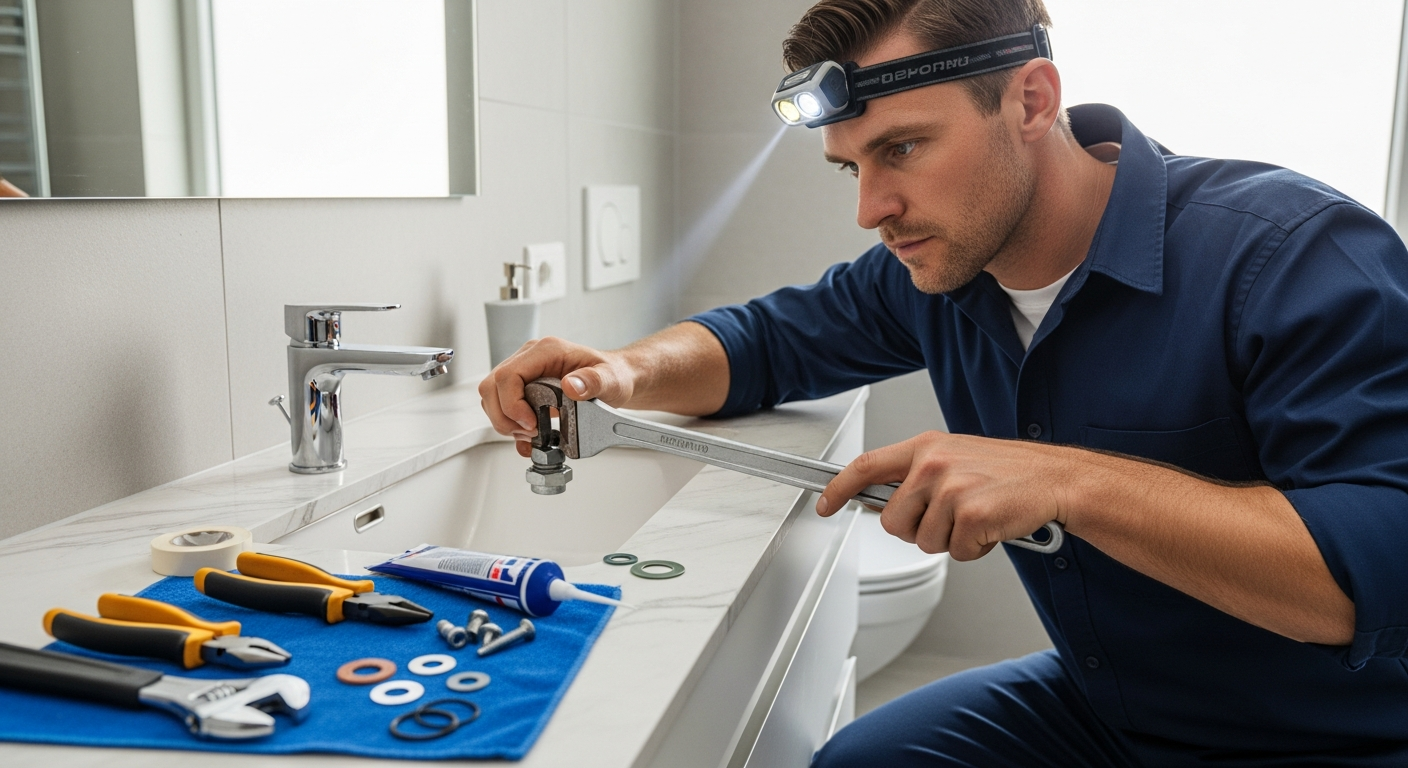
Gather these before you start. Having everything ready prevents a half-disassembled faucet from sitting overnight while you run to the hardware store.
- Adjustable wrench
- Phillips and flathead screwdrivers
- Allen wrench set (hex keys)
- Needle-nose pliers
- Replacement parts (washers, O-rings, cartridge, or repair kit matching your faucet brand/model)
- Plumber’s grease (silicone-based)
- Clean rags or towels
- Bucket or container
Pro tip: Take a photo of each step as you disassemble the faucet. This makes reassembly much easier, especially for ball-type faucets with many small parts.
How to Fix a Leaky Faucet: Step-by-Step
Step 1: Turn Off the Water Supply
Look under the sink for the shut-off valves. Turn both the hot and cold valves clockwise until they stop. Then open the faucet to release any remaining water pressure. If there are no shut-off valves under the sink, turn off the main water supply to the house.
Step 2: Identify Your Faucet Type
Remove the handle to see the internal mechanism:
- Rubber washer at the bottom of a stem = Compression faucet
- Metal ball with spring-loaded seals = Ball faucet
- Cylindrical cartridge = Cartridge faucet
- Wide ceramic cylinder = Ceramic disc faucet
Step 3: Disassemble the Faucet
For most faucets:
- Pry off the decorative cap on the handle (if present)
- Remove the screw holding the handle in place
- Pull the handle off (it may require gentle wiggling)
- Unscrew the packing nut with an adjustable wrench
- Pull out the stem, cartridge, or ball assembly
Step 4: Inspect and Replace Worn Parts
Compression faucet: Replace the rubber washer and O-ring at the bottom of the stem. Apply plumber’s grease to the new O-ring before installing.
Ball faucet: Replace the ball, springs, seats, and cam washer. Ball faucet repair kits include all these parts and cost $10 to $20.
Cartridge faucet: Pull out the old cartridge (note the orientation) and push in the replacement. Make sure the hot/cold alignment matches.
Ceramic disc: Remove the cylinder and inspect the discs. Clean sediment with white vinegar. If the discs are cracked or pitted, replace the entire cylinder.
Step 5: Reassemble and Test
- Reverse the disassembly steps to put everything back together
- Hand-tighten the packing nut first, then snug it with a wrench (do not overtighten)
- Reattach the handle and decorative cap
- Turn the water supply back on slowly
- Open the faucet and check for leaks around the handle and spout
When to Replace Instead of Repair
Sometimes a repair is not worth the effort. Consider replacing the entire faucet if:
- The faucet is more than 15 years old
- Replacement parts are no longer available for your model
- The valve seat is badly corroded (visible pitting or rough texture)
- The faucet body itself is cracked
- You have repaired the same faucet multiple times in the past year
- You want to upgrade to a more water-efficient model
A new faucet installation typically costs $150 to $400 including parts and labor, depending on the type and brand.
How Much Does a Leaky Faucet Cost You?
A faucet dripping once per second wastes approximately 3,000 gallons of water per year. In Orange County, where water rates average $0.008 to $0.012 per gallon, that adds $24 to $36 to your annual water bill, not counting the damage from moisture exposure around the faucet base.
More importantly, a persistent drip can cause:
- Staining and mineral deposits on sinks and fixtures
- Mold growth under sinks from constant moisture
- Damage to countertops and cabinetry
- Higher water bills that compound over months
When to Call a Professional Plumber
Some faucet leaks require more than a DIY fix:
- Leaking from the base of the faucet, which may indicate internal body cracks
- Corroded shut-off valves that will not turn or that leak when you touch them
- Supply line leaks behind the wall
- A faucet that leaks even after replacing internal parts
- Any leak you cannot trace to a visible source, which could indicate a slab leak or water heater leak
A licensed plumber can identify the exact issue and determine whether repair or replacement makes more financial sense for your situation.
Frequently Asked Questions
Can I fix a leaky faucet without turning off the water?
No. You must turn off the water supply before disassembling a faucet. Working on a faucet with the water on will cause flooding and makes it impossible to access internal components safely. Always shut off both the hot and cold supply valves under the sink before starting.
How long does it take to fix a leaky faucet?
A simple washer or O-ring replacement takes 15 to 30 minutes for someone comfortable with basic tools. Cartridge or ball faucet repairs take 30 to 60 minutes. If you need to replace the entire faucet, allow 1 to 2 hours including removing the old unit and installing the new one.
What causes a faucet to drip only at night?
Faucets that drip more at night usually respond to changes in water pressure. When demand in your neighborhood drops at night, pressure in the supply lines increases. A worn washer or cartridge that holds at normal pressure may fail under the higher nighttime pressure. Replacing the worn component fixes the problem.
Should I repair or replace a 20-year-old faucet?
Replace it. Most faucets have a functional lifespan of 15 to 20 years. A 20-year-old faucet likely has corrosion, mineral buildup, and worn internal components throughout. Even if you fix the current leak, another part will likely fail soon. Modern faucets are also more water-efficient, which can lower your monthly bills.
Related: Water Leak Detection
Need help with a leaky faucet or plumbing repair? Call 911 Drain Lines and Plumbing at (714) 746-7611 for fast, reliable service in Orange County and the Inland Empire. Licensed, insured, and available 24/7.